Reef is experimental and under heavy development. The language, standard library, and docs change often as we fix bugs and improve Reef — expect breaking changes between releases.
Every example compiles in CI; most also run there. Pick one to see its full source and the actual terminal session it produced.
Checksum CLI
Practical
A complete sha256sum-style tool in one file.
Source
// reefsum.reef - File checksum calculator
// Demonstrates: sys.optparse (CLI parsing), crypto modules, io.file, exit codes
//
// Usage:
//   reefsum sha256 file.txt
//   reefsum md5 file.txt
//   reefsum sha1 file.txt
//   reefsum crc32 file.txt
//   reefsum --help
//
// Exit codes:
//   0  - Success
//   1  - Error (file not found, unknown algorithm)
//   64 - Usage error (missing arguments)

import sys.optparse as opt
import io.file as file
import core.str as str
import core.result as result
import crypto.sha256 as sha256
import crypto.md5 as md5
import crypto.sha1 as sha1
import crypto.crc32 as crc32

// Calculate and print checksum
// Returns: true on success, false on error
fn calculate_checksum(algorithm: string, filename: string, uppercase: bool): bool
    // Check if file exists
    if not file.fileExists(filename)
        print("reefsum: ")
        print(filename)
        println(": No such file or directory")
        return false
    end if

    // Read file contents as binary (handles null bytes)
    let contents_r = file.readBinaryFile(filename)
    if result.is_err(contents_r)
        print("reefsum: ")
        print(filename)
        println(": error reading file")
        return false
    end if
    let contents = result.unwrap_ok(contents_r)

    // Calculate hash based on algorithm
    // All algorithms now support binary data with *_bytes functions
    mut hash = ""

    if str.equals(algorithm, "sha256")
        hash = sha256.sha256_bytes(contents)
    elif str.equals(algorithm, "sha1")
        hash = sha1.sha1_bytes(contents)
    elif str.equals(algorithm, "md5")
        hash = md5.md5_bytes(contents)
    elif str.equals(algorithm, "crc32")
        if uppercase
            hash = crc32.crc32_binary_hex(contents)
        else
            hash = crc32.crc32_binary_hex_lower(contents)
        end if
    else
        print("reefsum: unknown algorithm '")
        print(algorithm)
        println("'")
        println("Use --help to see supported algorithms.")
        return false
    end if

    // Print in standard checksum format: <hash>  <filename>
    print(hash)
    print("  ")
    println(filename)
    return true
end calculate_checksum

fn main(): int
    let p = opt.command("reefsum")
    p.about("Calculate checksums of files using various algorithms.")
    p.version("1.0.0")
    let upper = p.bool_flag("upper", 'u', false, "Output hash in uppercase (default: lowercase)")
    let algorithm = p.arg("algorithm")
    let files = p.rest()

    match p.parse()
        Status_OkHelp() =>
            return 0
        end
        Status_OkVersion() =>
            return 0
        end
        Status_Err(e) =>
            if opt.argc() < 2
                p.usage()
                return 0
            end if
            println("reefsum: " + opt.format(e))
            println("Try 'reefsum --help' for more information.")
            return 64
        end
        Status_OkParsed() =>
            if files.len() == 0
                println("reefsum: missing file operand")
                println("Try 'reefsum --help' for more information.")
                return 64
            end if
            let algo = algorithm.value()
            let uppercase = upper.value()
            mut had_error = false
            let names = files.values()
            mut i = 0
            while i < names.length()
                if not calculate_checksum(algo, names[i], uppercase)
                    had_error = true
                end if
                i = i + 1
            end while
            if had_error
                return 1
            end if
            return 0
        end
    end match
    return 0
end main
Parse, validate, and format JSON with typed errors.
Source
// json_pretty.reef - JSON pretty printer and viewer
// Demonstrates: encoding.json, io.file, io.console, core.str
//
// This example reads a JSON file and displays its contents in a
// formatted, human-readable way with indentation and type information.

import io.file as file
import io.console as console
import encoding.json as json
import core.str as str
import core.convert as convert
import core.result as result
import core.error as error
import core.option as option

// Get a human-readable type name
fn get_type_name(type_code: int): string
    if type_code == json.JSON_TYPE_NULL()
        return "null"
    elif type_code == json.JSON_TYPE_BOOL()
        return "boolean"
    elif type_code == json.JSON_TYPE_NUMBER()
        return "number"
    elif type_code == json.JSON_TYPE_STRING()
        return "string"
    elif type_code == json.JSON_TYPE_ARRAY()
        return "array"
    elif type_code == json.JSON_TYPE_OBJECT()
        return "object"
    else
        return "unknown"
    end if
end get_type_name

// Print indentation
proc print_indent(level: int)
    mut i = 0
    while i < level
        print("  ")
        i = i + 1
    end while
end print_indent

proc main()
    println("=================================")
    println("  JSON Pretty Printer")
    println("=================================")
    println("")

    // Get filename from user
    let filename = option.unwrap_or(console.readLinePrompt("Enter JSON filename: "), "")
    let path = str.trim_ws(str.chomp(filename))

    if str.is_empty(path)
        println("No filename provided.")
        return
    end if

    // Check if file exists
    if not file.fileExists(path)
        print("Error: File '")
        print(path)
        println("' not found.")
        return
    end if

    // Read the file
    let content_r = file.readFile(path)

    if result.is_err(content_r)
        println("File could not be read.")
        return
    end if

    let content = result.unwrap_ok(content_r)

    if str.is_empty(content)
        println("File is empty.")
        return
    end if

    println("")
    println("Parsing JSON...")
    println("")

    // Allocate arrays for parsing
    let keys = json.json_alloc_keys()
    let values = json.json_alloc_values()
    let types = json.json_alloc_types()

    // Parse the JSON (strict: malformed input is now Err, not a bare count)
    let parse_r = json.json_parse(content, keys, values, types)

    if result.is_err(parse_r)
        println("Error: Invalid JSON format.")
        print("  ")
        println(error.error_message(result.unwrap_err(parse_r)))
        return
    end if

    let count = result.unwrap_ok(parse_r)

    println("=================================")
    println("  Parsed JSON Contents")
    println("=================================")
    println("")

    print("Found ")
    print_int(count)
    println(" key-value pairs:")
    println("")

    // Display each key-value pair with type information
    mut i = 0
    while i < count
        let key = keys[i]
        let value = values[i]
        let type_code = types[i]

        // Determine nesting level by counting dots in the key
        mut level = 0
        mut j = 0
        let key_len = str.length(key)
        while j < key_len
            if str.char_at(key, j) == '.'
                level = level + 1
            end if
            j = j + 1
        end while

        // Print with indentation
        print_indent(level)

        // Extract just the leaf key name (after last dot)
        let last_dot = str.last_index_of_char(key, '.')
        mut display_key = key
        if last_dot >= 0
            display_key = str.substring(key, last_dot + 1, key_len - last_dot - 1)
        end if

        // Print key in bold format
        print("\"")
        print(display_key)
        print("\": ")

        // Print value based on type
        if type_code == json.JSON_TYPE_STRING()
            print("\"")
            print(value)
            print("\"")
        elif type_code == json.JSON_TYPE_NULL()
            print("null")
        elif type_code == json.JSON_TYPE_BOOL()
            print(value)
        elif type_code == json.JSON_TYPE_NUMBER()
            print(value)
        elif type_code == json.JSON_TYPE_ARRAY()
            print("[...]")
        elif type_code == json.JSON_TYPE_OBJECT()
            print("{...}")
        else
            print(value)
        end if

        // Print type annotation
        print("  (")
        print(get_type_name(type_code))
        println(")")

        i = i + 1
    end while

    println("")
    println("=================================")
    println("  Summary")
    println("=================================")
    println("")

    // Count types
    mut null_count = 0
    mut bool_count = 0
    mut number_count = 0
    mut string_count = 0
    mut array_count = 0
    mut object_count = 0

    i = 0
    while i < count
        let type_code = types[i]
        if type_code == json.JSON_TYPE_NULL()
            null_count = null_count + 1
        elif type_code == json.JSON_TYPE_BOOL()
            bool_count = bool_count + 1
        elif type_code == json.JSON_TYPE_NUMBER()
            number_count = number_count + 1
        elif type_code == json.JSON_TYPE_STRING()
            string_count = string_count + 1
        elif type_code == json.JSON_TYPE_ARRAY()
            array_count = array_count + 1
        elif type_code == json.JSON_TYPE_OBJECT()
            object_count = object_count + 1
        end if
        i = i + 1
    end while

    print("  Strings:  ")
    print_int(string_count)
    println("")
    print("  Numbers:  ")
    print_int(number_count)
    println("")
    print("  Booleans: ")
    print_int(bool_count)
    println("")
    print("  Nulls:    ")
    print_int(null_count)
    println("")
    print("  Arrays:   ")
    print_int(array_count)
    println("")
    print("  Objects:  ")
    print_int(object_count)
    println("")

    println("")
    println("Done!")
end main
TLS 1.3 via the system OpenSSL backend, ~90 lines.
Source
// HTTPS Test - Demonstrates net.http with HTTPS support
// Tests the HTTP client's ability to fetch content over HTTPS

import net.http
import core.str
import core.result as res
import core.error as error

proc main()
    println("=== HTTPS Test ===")
    println("")

    // Test HTTPS GET request
    println("Fetching https://www.google.com/ ...")
    let r = http.http_get("https://www.google.com/")

    if res.is_err(r)
        println("Request failed!")
        println("Error: " + error.error_message(res.unwrap_err(r)))
    else
        let response = res.unwrap_ok(r)
        if http.http_response_is_ok(response)
            println("Success!")
            println("Status: " + response.status_text)
            println("")
            println("Response headers:")
            mut i = 0
            while i < response.header_count and i < 5
                println("  " + response.headers[i])
                i = i + 1
            end while
            println("")
            println("Body length: " + int_to_str(str_length(response.body)) + " bytes")
            println("")
            println("First 200 chars of body:")
            println("---")
            if str_length(response.body) > 200
                println(str_substring(response.body, 0, 200))
            else
                println(response.body)
            end if
            println("---")
        else
            println("Request completed but status was not 2xx.")
            println("Status code: " + int_to_str(response.status_code))
        end if
    end if
end main

// Helper functions
fn str_length(s: string): int
    return str.length(s)
end str_length

fn str_substring(s: string, start: int, len: int): string
    return str.substring(s, start, len)
end str_substring

fn int_to_str(n: int): string
    if n == 0
        return "0"
    end if
    mut result = ""
    mut num = n
    while num > 0
        let digit = num - ((num / 10) * 10)
        mut digit_char = ""
        if digit == 0
            digit_char = "0"
        elif digit == 1
            digit_char = "1"
        elif digit == 2
            digit_char = "2"
        elif digit == 3
            digit_char = "3"
        elif digit == 4
            digit_char = "4"
        elif digit == 5
            digit_char = "5"
        elif digit == 6
            digit_char = "6"
        elif digit == 7
            digit_char = "7"
        elif digit == 8
            digit_char = "8"
        else
            digit_char = "9"
        end if
        result = str.concat(digit_char, result)
        num = num / 10
    end while
    return result
end int_to_str
Build, run & output
xterm
$ reefc https_test.reef -o ht$ ./ht
=== HTTPS Test ===
Fetching https://www.google.com/ ...
Success!
Status: OK
Response headers:
Content-Type: text/html; charset=ISO-8859-1
Date: Wed, 26 Aug 2026 16:55:43 GMT
Expires: -1
Cache-Control: private, max-age=0
Content-Security-Policy-Report-Only: object-src 'none';base-uri 'self';script-src 'nonce-jPaME85ovLeL_wrdD_da7Q' 'strict-dynamic' 'report-sample' 'unsafe-eval' 'unsafe-inline' https: http:;report-uri https://csp.withgoogle.com/csp/gws/other-hp
Body length: 83290 bytes
First 200 chars of body:
---
<!doctype html><html itemscope="" itemtype="http://schema.org/WebPage" lang="en"><head><meta content="Search the world's information, including webpages, images, videos and more. Google has many speci
---
Compression CLI
Systems
Links real zlib with `-l z` — C interop without bindings generators.
Source
// reefzip.reef - File compression utility
// Demonstrates: sys.optparse (CLI parsing), compress modules, io.file, exit codes
//
// BUILD: This example requires zlib (-lz):
//   reefc reefzip.reef -lz
//
// Usage:
//   reefzip lz4 file.txt              # Compress to file.txt.lz4
//   reefzip gzip file.txt             # Compress to file.txt.gz
//   reefzip zlib file.txt             # Compress to file.txt.zlib
//   reefzip -d lz4 file.txt.lz4       # Decompress
//   reefzip --help
//
// Exit codes:
//   0  - Success
//   1  - Error (file not found, compression/decompression failed)
//   64 - Usage error (missing arguments, unknown algorithm)

import sys.optparse as opt
import io.file as file
import core.str as str
import core.convert as convert
// Note: lz4 requires liblz4-dev to be installed
// import compress.lz4 as lz4
import compress.gzip as gzip
import compress.zlib as zlib

// Note: reef_fopen, reef_fclose, reef_fread, reef_fwrite, reef_fseek, reef_ftell
// are compiler builtins - no extern declaration needed

// Get file extension for algorithm
fn get_extension(algorithm: string): string
    if str.equals(algorithm, "lz4")
        return ".lz4"
    elif str.equals(algorithm, "gzip")
        return ".gz"
    elif str.equals(algorithm, "zlib")
        return ".zlib"
    end if
    return ".compressed"
end get_extension

// Read file into byte array
// Returns: number of bytes read, fills buffer
fn read_file_bytes(filename: string, buffer: [byte], max_size: int): int
    unsafe
        let fp: pointer = reef_fopen(filename, "rb")
        if fp == nil
            return -1
        end if

        // Get file size
        reef_fseek(fp, 0, 2)  // SEEK_END
        let file_size = reef_ftell(fp)
        reef_fseek(fp, 0, 0)  // SEEK_SET

        if file_size > max_size
            reef_fclose(fp)
            return -2  // File too large
        end if

        // Read file contents
        let buf_ptr: pointer = buffer as pointer
        let bytes_read = reef_fread(buf_ptr, 1, file_size, fp)
        reef_fclose(fp)

        return bytes_read
    end unsafe
end read_file_bytes

// Write byte array to file
fn write_file_bytes(filename: string, buffer: [byte], size: int): bool
    unsafe
        let fp: pointer = reef_fopen(filename, "wb")
        if fp == nil
            return false
        end if

        let buf_ptr: pointer = buffer as pointer
        let bytes_written = reef_fwrite(buf_ptr, 1, size, fp)
        reef_fclose(fp)

        return bytes_written == size
    end unsafe
end write_file_bytes

// Maximum file size (10 MB for demo)
fn MAX_FILE_SIZE(): int
    return 10 * 1024 * 1024
end MAX_FILE_SIZE

// Compress file
// Returns: true on success, false on error
fn compress_file(algorithm: string, input_file: string, output_file: string, level: int): bool
    // Check if input file exists
    if not file.fileExists(input_file)
        print("reefzip: ")
        print(input_file)
        println(": No such file or directory")
        return false
    end if

    // Allocate buffers (using zlib allocator)
    let input_buffer = zlib.zlib_alloc_buffer(MAX_FILE_SIZE())
    let output_buffer = zlib.zlib_alloc_buffer(MAX_FILE_SIZE() + 1024)  // Extra space for headers

    // Read input file
    let input_size = read_file_bytes(input_file, input_buffer, MAX_FILE_SIZE())

    if input_size < 0
        if input_size == -1
            print("reefzip: cannot open '")
            print(input_file)
            println("'")
        elif input_size == -2
            print("reefzip: file too large (max ")
            print_int(MAX_FILE_SIZE() / 1024 / 1024)
            println(" MB)")
        end if
        return false
    end if

    // Compress based on algorithm
    mut compressed_size = 0

    if str.equals(algorithm, "lz4")
        // LZ4 requires liblz4-dev - not available
        println("reefzip: lz4 algorithm requires liblz4-dev to be installed")
        println("  Use 'gzip' or 'zlib' instead")
        return false
    elif str.equals(algorithm, "gzip")
        let bound = gzip.gzip_compress_bound(input_size)
        compressed_size = gzip.gzip_compress(input_buffer, input_size, output_buffer, bound)
    elif str.equals(algorithm, "zlib")
        let bound = zlib.zlib_compress_bound(input_size)
        if level > 0
            compressed_size = zlib.zlib_compress_level(input_buffer, input_size, output_buffer, bound, level)
        else
            compressed_size = zlib.zlib_compress(input_buffer, input_size, output_buffer, bound)
        end if
    else
        print("reefzip: unknown algorithm '")
        print(algorithm)
        println("'")
        return false
    end if

    if compressed_size <= 0
        println("reefzip: compression failed")
        return false
    end if

    // Write output file
    if not write_file_bytes(output_file, output_buffer, compressed_size)
        print("reefzip: cannot write '")
        print(output_file)
        println("'")
        return false
    end if

    // Print summary
    print(input_file)
    print(" -> ")
    print(output_file)
    print(" (")
    print_int(input_size)
    print(" -> ")
    print_int(compressed_size)
    print(" bytes, ")
    let ratio = (compressed_size * 100) / input_size
    print_int(ratio)
    println("% of original)")
    return true
end compress_file

// Decompress file
// Returns: true on success, false on error
fn decompress_file(algorithm: string, input_file: string, output_file: string): bool
    // Check if input file exists
    if not file.fileExists(input_file)
        print("reefzip: ")
        print(input_file)
        println(": No such file or directory")
        return false
    end if

    // Allocate buffers (using zlib allocator)
    let input_buffer = zlib.zlib_alloc_buffer(MAX_FILE_SIZE())
    let output_buffer = zlib.zlib_alloc_buffer(MAX_FILE_SIZE())

    // Read input file
    let input_size = read_file_bytes(input_file, input_buffer, MAX_FILE_SIZE())

    if input_size < 0
        print("reefzip: cannot open '")
        print(input_file)
        println("'")
        return false
    end if

    // Decompress based on algorithm
    mut decompressed_size = 0

    if str.equals(algorithm, "lz4")
        // LZ4 requires liblz4-dev - not available
        println("reefzip: lz4 algorithm requires liblz4-dev to be installed")
        return false
    elif str.equals(algorithm, "gzip")
        decompressed_size = gzip.gzip_decompress(input_buffer, input_size, output_buffer, MAX_FILE_SIZE())
    elif str.equals(algorithm, "zlib")
        decompressed_size = zlib.zlib_decompress(input_buffer, input_size, output_buffer, MAX_FILE_SIZE())
    else
        print("reefzip: unknown algorithm '")
        print(algorithm)
        println("'")
        return false
    end if

    if decompressed_size <= 0
        println("reefzip: decompression failed (corrupted or wrong algorithm?)")
        return false
    end if

    // Write output file
    if not write_file_bytes(output_file, output_buffer, decompressed_size)
        print("reefzip: cannot write '")
        print(output_file)
        println("'")
        return false
    end if

    // Print summary
    print(input_file)
    print(" -> ")
    print(output_file)
    print(" (")
    print_int(input_size)
    print(" -> ")
    print_int(decompressed_size)
    println(" bytes)")
    return true
end decompress_file

// Remove extension from filename
fn remove_extension(filename: string, ext: string): string
    let flen = str.length(filename)
    let elen = str.length(ext)

    if flen > elen
        // Check if filename ends with ext
        let suffix = str.substring(filename, flen - elen, elen)
        if str.equals(suffix, ext)
            return str.substring(filename, 0, flen - elen)
        end if
    end if

    // Default: add .out extension
    return filename + ".out"
end remove_extension

fn main(): int
    let p = opt.command("reefzip")
    p.about("Compress or decompress files.")
    p.version("1.0.0")
    let decompress = p.bool_flag("decompress", 'd', false, "Decompress instead of compress")
    let output = p.string_flag("output", 'o', "", "Specify output file")
    let level_flag = p.int_flag("level", 'l', 6, "Compression level (1-9, default: 6)")
    let algorithm = p.arg("algorithm")
    let input = p.arg("file")

    match p.parse()
        Status_OkHelp() =>
            return 0
        end
        Status_OkVersion() =>
            return 0
        end
        Status_Err(e) =>
            if opt.argc() < 2
                p.usage()
                return 0
            end if
            println("reefzip: " + opt.format(e))
            println("Try 'reefzip --help' for more information.")
            return 64
        end
        Status_OkParsed() =>
            let algo = algorithm.value()
            let input_file = input.value()
            mut level = level_flag.value()
            if level < 1
                level = 1
            end if
            if level > 9
                level = 9
            end if

            mut output_file = input_file + get_extension(algo)
            if decompress.value()
                output_file = remove_extension(input_file, get_extension(algo))
            end if
            if output.present()
                output_file = output.value()
            end if

            if decompress.value()
                if decompress_file(algo, input_file, output_file)
                    return 0
                else
                    return 1
                end if
            else
                if compress_file(algo, input_file, output_file, level)
                    return 0
                else
                    return 1
                end if
            end if
        end
    end match
    return 0
end main
Build, run & output
xterm
$ reefc reefzip.reef -lz -o reefzip$ printf 'The quick brown fox jumps over the lazy dog.\n' > ./rz_demo.txt$ ./reefzip gzip ./rz_demo.txt
./rz_demo.txt -> ./rz_demo.txt.gz (45 -> 64 bytes, 142% of original)
$ ls -la ./rz_demo.txt.gz
-rw-rw-r-- 1 user user 64 Aug 26 11:55 ./rz_demo.txt.gz
$ ./reefzip -d gzip ./rz_demo.txt.gz
./rz_demo.txt.gz -> ./rz_demo.txt (64 -> 45 bytes)
$ cat ./rz_demo.txt
The quick brown fox jumps over the lazy dog.
Mandelbrot renderer
Systems
Tight float loops, renders a 400x300 PPM image (pre-rendered PNG in assets/) — compute code that reads clean.
Source
// mandelbrot.reef - Mandelbrot fractal generator
// Demonstrates: graphics.core, graphics.image, math.basic, io.file
//
// This example generates a Mandelbrot set fractal image and saves it
// as a PPM file. The Mandelbrot set is a famous mathematical fractal
// defined by the iteration z = z^2 + c in the complex plane.

import graphics.core as core
import graphics.image as image
import io.file as file
import io.console as console
import core.str as str
import core.convert as convert
import core.option as option
import math.basic as math
import sys.platform.runtime as runtime

// Image dimensions
fn IMG_WIDTH(): int
    return 400
end IMG_WIDTH

fn IMG_HEIGHT(): int
    return 300
end IMG_HEIGHT

// Maximum iterations for escape test
fn MAX_ITER(): int
    return 100
end MAX_ITER

// Mandelbrot set boundaries (viewing window)
fn X_MIN(): float
    return 0.0 - 2.5
end X_MIN

fn X_MAX(): float
    return 1.0
end X_MAX

fn Y_MIN(): float
    return 0.0 - 1.25
end Y_MIN

fn Y_MAX(): float
    return 1.25
end Y_MAX

// Calculate escape iteration count for a point
// Returns 0 to MAX_ITER (0 = in set, 1-MAX_ITER = escaped)
fn mandelbrot_escape(c_re: float, c_im: float): int
    mut z_re = 0.0
    mut z_im = 0.0
    mut iter = 0
    let max = MAX_ITER()

    while iter < max
        // z^2 = (a + bi)^2 = a^2 - b^2 + 2ab*i
        let z_re_sq = z_re * z_re
        let z_im_sq = z_im * z_im

        // Check escape: |z|^2 > 4
        if z_re_sq + z_im_sq > 4.0
            return iter
        end if

        // z = z^2 + c
        let new_re = z_re_sq - z_im_sq + c_re
        let new_im = 2.0 * z_re * z_im + c_im
        z_re = new_re
        z_im = new_im

        iter = iter + 1
    end while

    return 0  // Didn't escape - likely in the set
end mandelbrot_escape

// Convert iteration count to a color
fn iter_to_color(iter: int, max_iter: int): core.Color
    if iter == 0
        // In the set - black
        return core.black()
    end if

    // Map iteration to a color using HSV-like coloring
    // This creates a nice gradient from blue to red to yellow to white

    // Normalize iteration to 0-1 range
    let t = (iter * 255) / max_iter

    // Create color based on escape speed
    // Faster escape = brighter/warmer colors
    mut r = 0
    mut g = 0
    mut b = 0

    if t < 64
        // Blue to cyan
        r = 0
        g = t * 4
        b = 255
    elif t < 128
        // Cyan to green
        r = 0
        g = 255
        b = 255 - (t - 64) * 4
    elif t < 192
        // Green to yellow
        r = (t - 128) * 4
        g = 255
        b = 0
    else
        // Yellow to red
        r = 255
        g = 255 - (t - 192) * 4
        b = 0
    end if

    // Clamp values
    if r > 255
        r = 255
    end if
    if g > 255
        g = 255
    end if
    if b > 255
        b = 255
    end if
    if r < 0
        r = 0
    end if
    if g < 0
        g = 0
    end if
    if b < 0
        b = 0
    end if

    unsafe
        return core.rgb(r as byte, g as byte, b as byte)
    end unsafe
end iter_to_color

// Alternative color scheme: smooth coloring
fn iter_to_color_smooth(iter: int, max_iter: int): core.Color
    if iter == 0
        return core.black()
    end if

    // Use multiple passes through the color wheel
    let t = ((iter * 5) % 256)

    mut r = 0
    mut g = 0
    mut b = 0

    // Sinusoidal color scheme approximation
    if t < 85
        r = t * 3
        g = 255 - t * 3
        b = 0
    elif t < 170
        let adjusted_t = t - 85
        r = 255 - adjusted_t * 3
        g = 0
        b = adjusted_t * 3
    else
        let adjusted_t = t - 170
        r = 0
        g = adjusted_t * 3
        b = 255 - adjusted_t * 3
    end if

    if r > 255
        r = 255
    end if
    if g > 255
        g = 255
    end if
    if b > 255
        b = 255
    end if

    unsafe
        return core.rgb(r as byte, g as byte, b as byte)
    end unsafe
end iter_to_color_smooth

// Save image as PPM format using direct file I/O
// Uses compiler builtin functions: reef_fopen, reef_fclose, reef_fputs
// This writes incrementally to avoid O(n²) string concatenation
fn save_as_ppm(img: image.Image, filename: string): bool
    let w = image.image_width(img)
    let h = image.image_height(img)

    unsafe
        let fp: pointer = reef_fopen(filename, "w")
        if fp == nil
            return false
        end if

        // Write header
        let _ = reef_fputs("P3\n", fp)
        let _ = reef_fputs(convert.to_string(w), fp)
        let _ = reef_fputs(" ", fp)
        let _ = reef_fputs(convert.to_string(h), fp)
        let _ = reef_fputs("\n255\n", fp)

        // Write pixel data row by row
        mut y = 0
        while y < h
            mut x = 0
            while x < w
                let color = image.get_pixel(img, x, y)

                let r: int = color.r
                let g: int = color.g
                let b: int = color.b

                let _ = reef_fputs(convert.to_string(r), fp)
                let _ = reef_fputs(" ", fp)
                let _ = reef_fputs(convert.to_string(g), fp)
                let _ = reef_fputs(" ", fp)
                let _ = reef_fputs(convert.to_string(b), fp)

                if x < w - 1
                    let _ = reef_fputs(" ", fp)
                end if

                x = x + 1
            end while
            let _ = reef_fputs("\n", fp)
            y = y + 1
        end while

        reef_fclose(fp)
    end unsafe

    return true
end save_as_ppm

// Generate the Mandelbrot fractal
proc generate_mandelbrot(img: image.Image, use_smooth: bool)
    let w = image.image_width(img)
    let h = image.image_height(img)
    let max_iter = MAX_ITER()

    // Calculate scale factors for mapping pixels to complex plane
    let x_range = X_MAX() - X_MIN()
    let y_range = Y_MAX() - Y_MIN()

    let h_f = runtime.reef_int_to_float(h - 1)
    let w_f = runtime.reef_int_to_float(w - 1)

    mut y = 0
    while y < h
        // Map pixel y to imaginary part
        let y_f = runtime.reef_int_to_float(y)
        let c_im = Y_MIN() + (y_f * y_range) / h_f

        mut x = 0
        while x < w
            // Map pixel x to real part
            let x_f = runtime.reef_int_to_float(x)
            let c_re = X_MIN() + (x_f * x_range) / w_f

            // Calculate escape iteration
            let iter = mandelbrot_escape(c_re, c_im)

            // Convert to color
            let color = if use_smooth then
                iter_to_color_smooth(iter, max_iter)
            else
                iter_to_color(iter, max_iter)
            end if

            image.set_pixel(img, x, y, color)

            x = x + 1
        end while

        // Progress indicator every 30 rows
        if y % 30 == 0
            print("  Row ")
            print_int(y)
            print("/")
            print_int(h)
            println("")
        end if

        y = y + 1
    end while
end generate_mandelbrot

proc main()
    println("=================================")
    println("  Mandelbrot Fractal Generator")
    println("=================================")
    println("")
    println("This program generates an image of the Mandelbrot set,")
    println("one of the most famous fractals in mathematics.")
    println("")

    // Ask for color scheme
    println("Color schemes:")
    println("  1. Gradient (blue to red)")
    println("  2. Smooth cycling colors")
    let scheme_input = option.unwrap_or(console.readLinePrompt("Choose color scheme (1-2): "), "")
    let scheme = str.trim_ws(str.chomp(scheme_input))
    let use_smooth = str.equals(scheme, "2")

    println("")
    print("Image size: ")
    print_int(IMG_WIDTH())
    print("x")
    print_int(IMG_HEIGHT())
    println("")
    print("Max iterations: ")
    print_int(MAX_ITER())
    println("")
    println("")
    println("Generating fractal (this may take a moment)...")
    println("")

    // Create the image
    let img = image.create_image_rgba(IMG_WIDTH(), IMG_HEIGHT())

    // Clear to black
    image.clear(img, core.black())

    // Generate the fractal
    generate_mandelbrot(img, use_smooth)

    println("")
    println("Generation complete!")
    println("")

    // Get filename
    let default_name = "mandelbrot.ppm"
    print("Save as (default: ")
    print(default_name)
    let input = option.unwrap_or(console.readLinePrompt("): "), "")
    let trimmed = str.trim_ws(str.chomp(input))

    let filename = if str.is_empty(trimmed) then default_name else trimmed end if

    print("Saving to ")
    print(filename)
    println("...")

    if save_as_ppm(img, filename)
        println("")
        println("Success! Mandelbrot fractal saved.")
        println("")
        println("To view the image:")
        println("  - Open with any image viewer that supports PPM")
        print("  - Convert to PNG: convert ")
        print(filename)
        println(" mandelbrot.png")
        println("")
        println("Fun facts about the Mandelbrot set:")
        println("  - Discovered by Benoit Mandelbrot in 1980")
        println("  - Has infinite detail at any zoom level")
        println("  - The boundary has a fractal dimension of 2")
        println("  - Contains infinitely many copies of itself")
    else
        println("")
        println("Error: Failed to save the file.")
    end if

    println("")
    println("Done!")
end main
Build, run & output
xterm
$ reefc mandelbrot.reef -o mb$ printf '1\nmb_demo.ppm\n' | ./mb
=================================
Mandelbrot Fractal Generator
=================================
This program generates an image of the Mandelbrot set,
one of the most famous fractals in mathematics.
Color schemes:
1. Gradient (blue to red)
2. Smooth cycling colors
Choose color scheme (1-2):
Image size: 400x300
Max iterations: 100
Generating fractal (this may take a moment)...
Row 0/300
Row 30/300
Row 60/300
Row 90/300
Row 120/300
Row 150/300
Row 180/300
Row 210/300
Row 240/300
Row 270/300
Generation complete!
Save as (default: mandelbrot.ppm): Saving to mb_demo.ppm...
Success! Mandelbrot fractal saved.
To view the image:
- Open with any image viewer that supports PPM
- Convert to PNG: convert mb_demo.ppm mandelbrot.png
Fun facts about the Mandelbrot set:
- Discovered by Benoit Mandelbrot in 1980
- Has infinite detail at any zoom level
- The boundary has a fractal dimension of 2
- Contains infinitely many copies of itself
Done!
$ ls -la ./mb_demo.ppm
-rw-rw-r-- 1 user user 1001749 Aug 26 11:55 ./mb_demo.ppm
$ head -c 40 ./mb_demo.ppm
P3
400 300
255
0 8 255 0 8 255 0 8 255 0
The 400×300 PPM the run above wrote, converted to PNG.
ReefVision hello
Systems
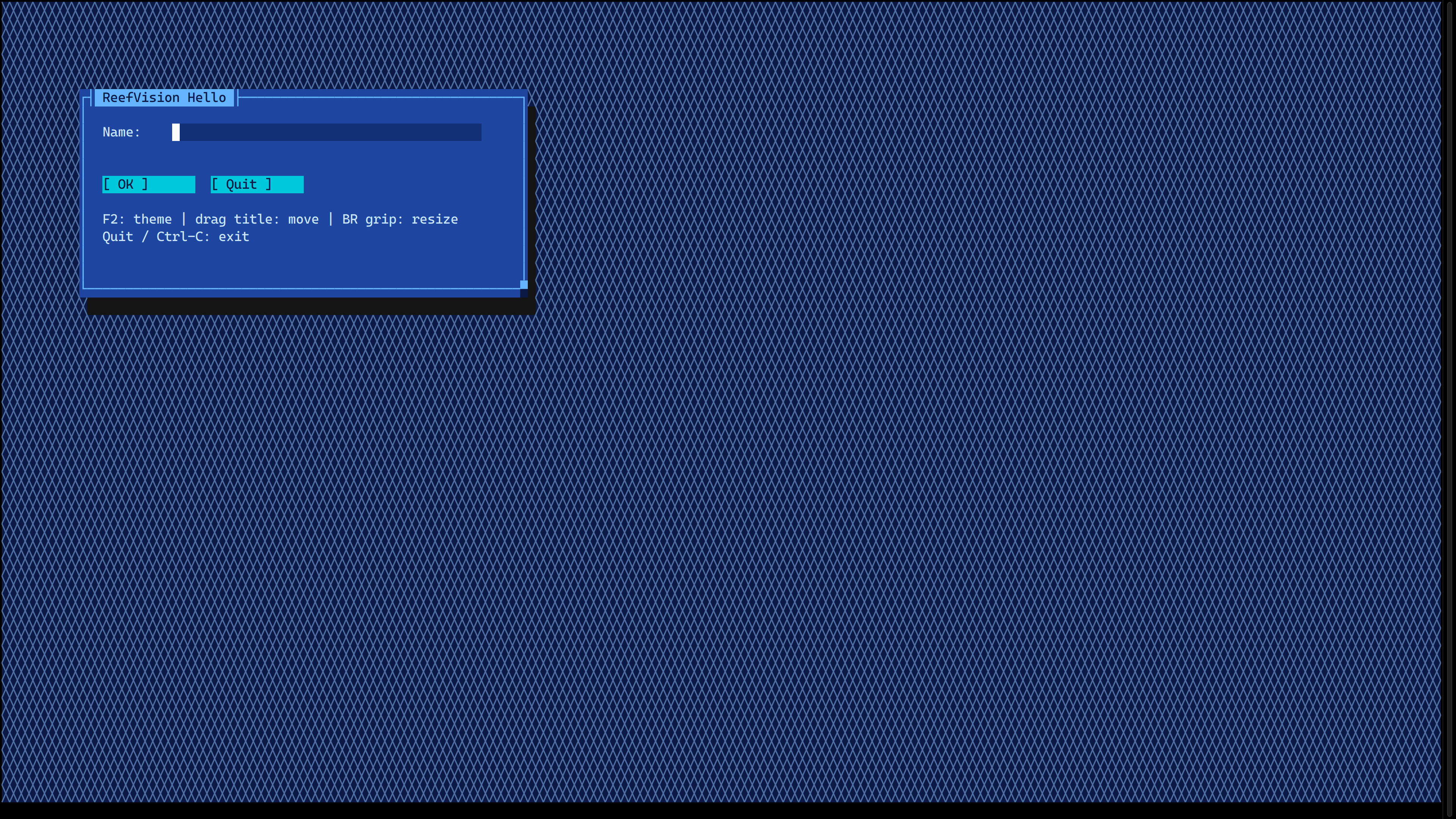
A Name field, OK / Quit, and a Greeting MessageBox — ReefVision widgets on a TTY desktop.
Source
// Site excerpt — full sample: examples/reefvision_hello.reef in reef-lang.
module main

import reefvision.cell as cell
import reefvision.desktop as desktop
import reefvision.event as event
import reefvision.theme as theme
import reefvision.view as view
import reefvision.widgets.button as button
import reefvision.widgets.inputline as inputline
import reefvision.widgets.label as label
import reefvision.widgets.messagebox as msgbox
import reefvision.widgets.window as window

fn main(): int
    mut app = new desktop.Application(theme.default_theme())
    mut win = new window.Window(cell.rect(10, 5, 58, 12), "ReefVision Hello")
    let name = new inputline.InputLine(cell.rect(11, 1, 40, 1), 48, "")

    win.add(new label.Label(cell.rect(2, 1, 8, 1), "Name:"))
    win.add(name)
    win.add(new button.Button(cell.rect(2, 4, 12, 1), "OK", event.CMD_OK()))
    win.add(new button.Button(cell.rect(16, 4, 12, 1), "Quit", event.CMD_QUIT()))
    app.desktop.add(win)

    if not app.open()
        println("not a TTY; refusing to run.")
        return 1
    end if

    while app.running
        app.do_step()
        let cmd = app.last_command
        if cmd == event.CMD_OK()
            app.clear_command()
            mut msg = "Hello!"
            if name.text != ""
                msg = "Hello, ${name.text}!"
            end if
            let _r = app.message_box("Greeting", msg, msgbox.messagebox_kind_ok())
        elif cmd == event.CMD_QUIT()
            app.quit()
        end if
    end while

    app.close()
    return 0
end main

end module
ReefVision Hello — Name InputLine, OK / Quit (Cobalt).
Concurrent hasher
Concurrency
Worker Active Objects with their own threads, no locks in user code.
Source
// parallel_hash.reef - Concurrent file checksums with Active Objects
// Demonstrates: worker AOs with run() threads, await-gated queues,
//               io.dir, io.file, crypto.sha256, sys.optparse
//
// Usage:
//   parallel_hash <directory>
//
// Hashes every regular file directly inside <directory> with SHA-256.
// Work is spread across 4 worker Active Objects, each with its own
// thread; a collector Active Object aggregates results; main prints
// them sorted by filename, sha256sum-style.

import sys.optparse as opt
import io.dir as dir
import io.file as file
import crypto.sha256 as sha256
import core.result as result
import core.str as str

active object Collector
    names: [string]
    digests: [string]
    count: int
    target: int

    init()
        self.names = new [string](0)
        self.digests = new [string](0)
        self.count = 0
        self.target = 0
    end init

    exclusive proc add(name: string, digest: string)
        self.names = self.names.append(name)
        self.digests = self.digests.append(digest)
        self.count = self.count + 1
    end add

    // Blocks until every dispatched file is hashed. self.target holds
    // the parameter: await conditions only close over self, not locals.
    exclusive proc wait_for(expected: int)
        self.target = expected
        await self.count == self.target
    end wait_for

    exclusive fn digest_for(name: string): string
        mut i = 0
        while i < self.count
            if str.equals(self.names[i], name)
                return self.digests[i]
            end if
            i = i + 1
        end while
        return "?"
    end digest_for
end Collector

active object Worker
    queue: [string]
    done: bool
    sink: Collector

    init(sink: Collector)
        self.queue = new [string](0)
        self.done = false
        self.sink = sink
    end init

    exclusive proc submit(path: string)
        self.queue = self.queue.append(path)
    end submit

    exclusive proc finish()
        self.done = true
    end finish

    // Blocks until a path is queued or finish() was called; "" means
    // done-and-drained. The await lives here, not in run() directly,
    // and run() reaches it via a (legal) exclusive self-call.
    exclusive fn take(): string
        await self.queue.length() > 0 or self.done
        if self.queue.length() == 0
            return ""
        end if
        let path = self.queue[0]
        self.queue = self.queue.remove(0)
        return path
    end take

    run()
        loop
            let path: string = self.take()
            if str.equals(path, "")
                break
            end if
            let contents_r = file.readBinaryFile(path)
            if result.is_ok(contents_r)
                self.sink.add(path, sha256.sha256_bytes(result.unwrap_ok(contents_r)))
            else
                self.sink.add(path, "(unreadable)")
            end if
        end loop
    end run
end Worker

// Selection sort using only append/remove (Reef arrays have no insert).
fn sorted(items: [string]): [string]
    mut remaining: [string] = items
    mut out: [string] = new [string](0)
    while remaining.length() > 0
        mut min_i = 0
        mut i = 1
        while i < remaining.length()
            if str.compare(remaining[i], remaining[min_i]) < 0
                min_i = i
            end if
            i = i + 1
        end while
        out = out.append(remaining[min_i])
        remaining = remaining.remove(min_i)
    end while
    return out
end sorted

proc main()
    let p = opt.command("parallel_hash")
    p.about("Hash files in parallel")
    let directory = p.arg("directory")
    mut root = ""
    match p.parse()
        Status_OkParsed() =>
            root = directory.value()
        end
        Status_OkHelp() =>
            return
        end
        Status_OkVersion() =>
            return
        end
        Status_Err(e) =>
            println("parallel_hash: " + opt.format(e))
            return
        end
    end match
    let listing_r = dir.list_dir(root)
    if result.is_err(listing_r)
        println("parallel_hash: cannot read directory: ${root}")
        return
    end if

    // Keep regular files only.
    mut files: [string] = new [string](0)
    let entries = result.unwrap_ok(listing_r)
    for entry in entries
        let path = root + "/" + entry
        if not dir.is_directory(path)
            files = files.append(path)
        end if
    end for

    let collector = new Collector()
    let workers = [new Worker(collector), new Worker(collector),
                   new Worker(collector), new Worker(collector)]
    mut i = 0
    for path in files
        workers[i % 4].submit(path)
        i = i + 1
    end for
    for w in workers
        w.finish()
    end for
    collector.wait_for(files.length())

    let ordered = sorted(files)
    for path in ordered
        println("${collector.digest_for(path)}  ${path}")
    end for
end main
A widget tree: inheritance, virtual dispatch, typecase.
Source
// 0.9 Phase 9 M3: widget-tree showcase. A small hierarchy, virtual
// dispatch through a Base-typed list, typecase, and the
// delegate-to-virtual trait pattern (spec §4.5). D42: the trait method
// is a different name from the class virtual it forwards to.

object Widget
    id: string

    init(id: string)
        self.id = id
    end init

    shared fn kind(): string
        return "widget"
    end kind

    shared fn render(): string
        return "<widget ${self.id}/>"
    end render
end Widget

object Label extends Widget
    text: string

    init(id: string, text: string)
        inherited init(id)
        self.text = text
    end init

    override shared fn kind(): string
        return "label"
    end kind

    override shared fn render(): string
        return "<label ${self.id}>${self.text}</label>"
    end render
end Label

object Button extends Widget
    text: string

    init(id: string, text: string)
        inherited init(id)
        self.text = text
    end init

    override shared fn kind(): string
        return "button"
    end kind

    override shared fn render(): string
        return "<button ${self.id}>${self.text}</button>"
    end render
end Button

object Panel extends Widget
    kids: [Widget]

    init(id: string)
        inherited init(id)
        self.kids = new [Widget](0)
    end init

    exclusive proc add(c: Widget)
        self.kids = self.kids.append(c)
    end add

    override shared fn kind(): string
        return "panel"
    end kind

    override shared fn render(): string
        mut s = "<panel ${self.id}>"
        let n = self.kids.length()
        for i in 0..n
            s = s + self.kids[i].render()
        end for
        return s + "</panel>"
    end render
end Panel

trait Printable
    fn show(): string;
end Printable

impl Printable for Widget
    fn show(): string
        return self.kind()
    end show
end impl

fn describe[T](x: T): string where T: Printable
    return x.show()
end describe

proc tag_of(w: Widget)
    typecase w
        Button b =>
            println("typecase: button ${b.text}")
        end
        Label l =>
            println("typecase: label ${l.text}")
        end
        Panel p =>
            println("typecase: panel ${p.id}")
        end
        else =>
            println("typecase: other")
        end
    end typecase
end tag_of

proc main()
    let root = new Panel("root")
    let hello = new Label("h", "hello")
    let ok = new Button("b", "ok")
    root.add(hello)
    root.add(ok)

    println("kinds: ${root.kind()} ${hello.kind()} ${ok.kind()}")

    let w: Widget = ok
    println("virtual: ${w.kind()}")
    println("trait-base: ${w.show()}")
    println("trait-derived: ${ok.show()}")
    println("generic: ${describe(ok)}")

    tag_of(ok)
    tag_of(hello)
    tag_of(root)

    println("tree: ${root.render()}")
    println("widget-tree: OK")
end main
The same language, freestanding, booting under QEMU.
Source
// kernel_limine.reef - Minimal Limine kernel in Reef
// Uses framebuffer output via reef_putchar

// ============================================================
// CPU Control (still useful for halting)
// ============================================================

// Halt CPU (wait for interrupt)
asm proc hlt() for amd64
    HLT
end hlt

// ============================================================
// Kernel Main - prints messages using reef_putchar (from limine_boot.c)
// ============================================================

// External: reef_putchar is provided by limine_boot.c
extern "C" proc reef_putchar(c: char)

// Helper to print a string
proc print_string(s: string)
    mut i = 0
    // BUG-123: reading s[i] up to and including the NUL terminator requires
    // unsafe -- the checked form panics on the index == length read that
    // this idiom needs (same idiom as core.str.length, which wraps it the
    // same way).
    unsafe
        mut ch = s[i]
        while ch != '\0'
            reef_putchar(ch)
            i = i + 1
            ch = s[i]
        end while
    end unsafe
end print_string

proc main()
    // Print welcome message
    print_string("================================")
    reef_putchar('\n')
    print_string("  Reef OS - Limine Edition")
    reef_putchar('\n')
    print_string("================================")
    reef_putchar('\n')
    reef_putchar('\n')

    print_string("Hello from Reef!")
    reef_putchar('\n')

    print_string("Kernel booted successfully.")
    reef_putchar('\n')
    reef_putchar('\n')

    print_string("Features:")
    reef_putchar('\n')
    print_string("  - Inline assembly (x86-64)")
    reef_putchar('\n')
    print_string("  - Limine boot protocol")
    reef_putchar('\n')
    print_string("  - Framebuffer graphics")
    reef_putchar('\n')
    reef_putchar('\n')

    print_string("System halted.")
    reef_putchar('\n')

    // Halt loop
    loop
        hlt()
    end loop
end main
Build, run & output
xterm
$ make -f Makefile.limine iso$ qemu-system-x86_64 -cdrom build-limine/reef-os.iso -serial stdio -display none
=== Reef OS Limine Kernel ===
Serial initialized.
Limine base revision OK.
Framebuffer acquired.
Screen cleared.
Calling reef_main()...
================================
Reef OS - Limine Edition
================================
Hello from Reef!
Kernel booted successfully.
Features:
- Inline assembly (x86-64)
- Limine boot protocol
- Framebuffer graphics
System halted.